
What actually separates a forgettable resort from one guests talk about for years — drawn from real projects across Dhaka, Cox’s Bazar, and Sylhet.
Resort interiors succeed on consistency of material and tone, not on how much was spent.
The region — coastal, tea garden, or riverine — should shape the design, not be an afterthought.
Coordinating interior design with the architecture from the start avoids costly rework later.
Luxury resort interior design in Bangladesh blends the local landscape — coastal, tea garden, or riverine — with five-star comfort and biophilic materials. The strongest resorts repeat materials and tones across every space, from guest suites to lobbies, so the design feels intentional rather than assembled.
Designing a resort is not the same job as designing a home or an office.
A residential project answers to one owner’s taste. A resort has to work for hundreds of guests who pass through it every month, each forming a first impression in the first ten minutes. The design has to perform for a stranger on day one the same way it performs for a returning guest on their fifth visit.
A few things change the brief entirely:
Guest flow over personal taste. Every room has to read clearly to someone walking in for the first time — there’s no one there to explain the layout.
Architecture and interior have to move together. The way a building captures light and frames a view sets the limits for what the interior can do. The two disciplines work best when they start at the same table, not in sequence.
Durability matters as much as beauty. A finish that looks stunning on day one but stains within a season costs more in the long run than it saves upfront, especially in Bangladesh’s humidity and monsoon season.
Operations stay invisible. Staff areas, maintenance access, and service routes need to function smoothly without ever showing up in a guest’s experience of the space.
There’s also a financial reality behind all of this. A residential project is judged once, by one client, at handover. A resort is judged every single day, by every guest who books a room, and that judgment shows up directly in occupancy rates and repeat bookings. The interior isn’t just decoration here — it’s part of how the property earns its income.
The biggest mistake in resort design isn’t a wrong color choice — it’s designing the same room for Cox’s Bazar, Sylhet, and a riverine retreat.
Each setting asks for a different response, and the resorts that get remembered are usually the ones that listened to their site first.
Cox’s Bazar (coastal)
Cox’s Bazar (coastal)
Cox’s Bazar (coastal)
Open, breezy, sea-facing sightlines
Open, breezy, sea-facing sightlines
Open, breezy, sea-facing sightlines
Sun-resistant timber, woven textures, salt-tolerant finishes
Sun-resistant timber, woven textures, salt-tolerant finishes
Sun-resistant timber, woven textures, salt-tolerant finishes
A coastal property facing the Bay of Bengal can lean into open, breezy layouts with sea-facing sightlines — but the same openness in a humid tea-garden retreat would let in moisture and insects the design then has to fight. In the hills around Sylhet, framing the green landscape through large glazing does more for the guest experience than any imported finish ever could. Riverine and rural retreats reward a quieter palette: jute, terracotta, natural fiber, materials that don’t compete with the water around them.
Coastal properties face a specific set of design problems before they face an aesthetic one. Salt air corrodes untreated metal within a season, humidity warps poorly sealed timber, and direct sun fades fabric faster than most owners expect. The fix isn’t to avoid these materials — it’s to specify the right grade of them. Marine-grade hardware, sealed and treated local timber, and weave-based textiles that breathe rather than trap moisture all hold up to a Cox’s Bazar climate in a way that standard interior-grade materials simply don’t. Open floor plans with cross-ventilation also reduce dependence on air conditioning, which matters both for guest comfort during power fluctuations and for long-term operating cost.
Hill and tea-garden properties around Sylhet ask for the opposite instinct. Instead of opening the building up to the elements, the design should frame them — large glazing positioned to capture a specific view, rather than wraparound windows that expose every angle. Stone and timber sourced from the region root the building in its surroundings, and a slightly more enclosed, layered interior suits the cooler hill climate better than the breezy openness that works on the coast. Biophilic touches — indoor planting, natural light wells, materials left close to their raw state — do more work here than anywhere else in the country, because the landscape outside is already doing half the job.
Riverine and rural retreats are the quietest category, and the design should match that. These properties often draw guests looking for stillness rather than spectacle, so material choices lean toward natural fiber rugs, terracotta tile, and jute — textures that feel grounded rather than performative. Water-facing rooms benefit from low, unobstructed sightlines rather than ornate framing; the river itself is the feature, and the interior’s job is to get out of its way.
This is also where local material choice earns its place — not as decoration, but as a practical response to climate. Salt-tolerant finishes near the coast last years longer than imports that weren’t built for the air. Locally sourced stone or timber in a hill resort tells a more honest story than marble shipped in from elsewhere, and it’s usually the better-performing choice too.

The guest suite is where a resort either earns its rate or doesn’t. A few choices do most of the work:
The bed as the centerpiece. A custom headboard and layered lighting say more about quality than any other single element in the room. Overhead lighting alone makes even a well-furnished room feel flat and institutional a bedside sconce, a soft ambient wash, and one accent source together do more to signal comfort than a brighter bulb ever will.
Bathrooms as private spas. Natural materials and daylight turn a functional bathroom into one of the most-photographed parts of the stay. A skylight, a stone vanity, or even a single indoor plant changes the entire register of the space from purely functional to genuinely restorative.
Furniture arranged to frame the view. If the room has a sea, garden, or river view, every seat in it should be positioned to use it not fight it. This sounds obvious, but it’s one of the most common oversights in resort rooms: a desk or wardrobe placed where it blocks the one window that should have been the room’s main draw.
None of this needs to be expensive. It needs to be deliberate. A room with three carefully chosen, well-lit elements will photograph and feel better than one with ten competing decorative pieces and a single harsh overhead light.
The lobby sets what’s often called the “sense of arrival” the first material a guest touches, the ceiling height, the way light falls when they walk in. Get this right and the rest of the stay starts on the right footing. A double-height ceiling with a single strong material statement a feature wall, a locally crafted screen, a considered piece of furniture does more for that first impression than a room full of smaller decorative choices ever could.
Lounges and bars ask for a different mood than the lobby: texture over scale. Velvet, leather, and wood layered together create the kind of unhurried, social feel that makes a guest want to linger rather than pass through. Acoustic comfort matters here too a lounge where conversation carries across the room feels less private and less relaxed than one where soft furnishings and layout naturally absorb sound.
Common areas are also where local craft earns its place murals, ceramics, and textiles from local artisans give a property a story that can’t be copied by a competitor down the coast. This is one of the few parts of a resort where culture and design serve the exact same goal at once: a handwoven textile or a locally commissioned mural costs less than imported art and tells a far more specific story about where the resort actually is.
A resort rarely has just one restaurant, and each one should speak a different language. Fine dining calls for a more formal, elegant register; a poolside cafe should feel bright and unforced. Forcing one design language across every food and beverage outlet flattens the experience guests came for, and makes a property with three restaurants feel like it only really has one idea.
Spas and yoga pavilions need privacy, daylight, and quiet above almost anything else these are the spaces where the design’s job is to disappear and let stillness take over. Materials here should feel soft underfoot and visually calm: nothing glossy, nothing that reflects light aggressively, nothing that competes for attention with the treatment or practice happening in the room.
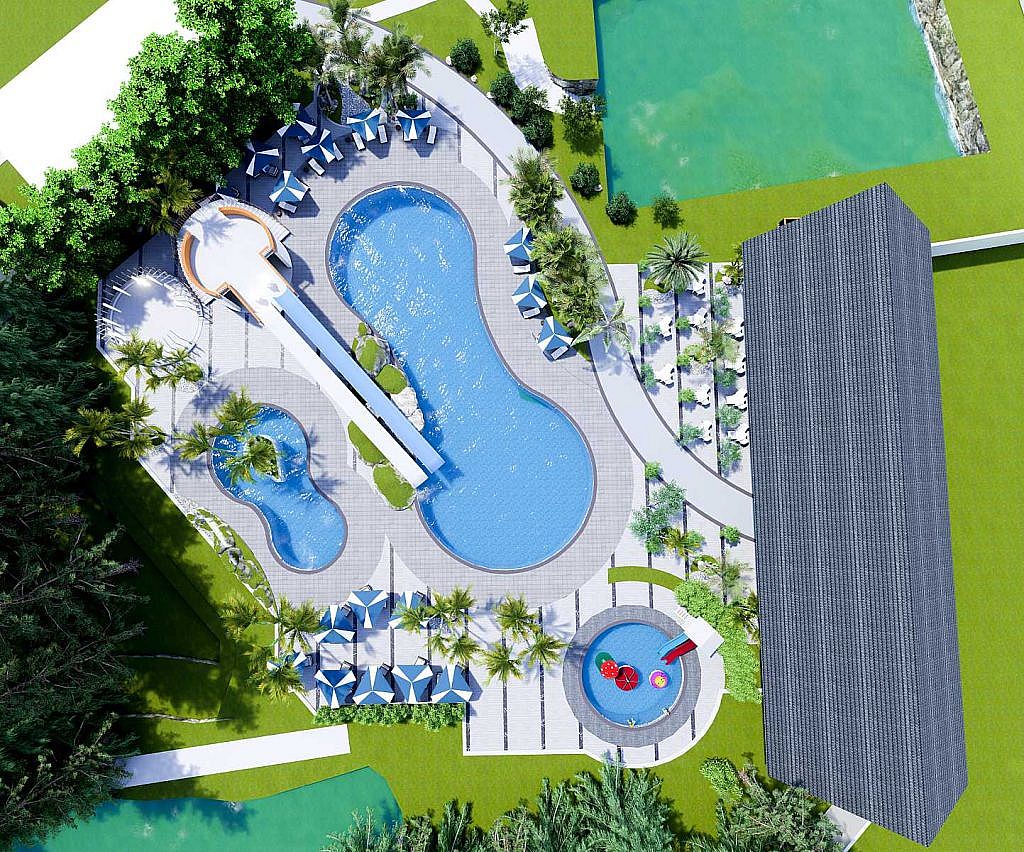
Pool decks, by contrast, are often the most photographed corner of the entire property. They deserve as much design attention as any guest suite, because for many visitors, that’s the image that sells the resort to the next guest. Seating that’s comfortable for hours, shade that doesn’t block the view, and a clear visual line between the pool, the landscape, and the architecture all matter more here than any single decorative detail.
Modern travelers expect a resort to run smoothly without ever noticing the systems behind it. A few priorities matter more than the rest:
Simple control. Lighting, curtains, and temperature that respond from a phone or a clean in-room panel, not a wall of switches.
Charging that’s built in. Ports set into furniture, not loose adapters and visible cords trailing across a nightstand.
Technology that disappears. The best resort automation is the kind a guest never has to think about it’s only noticed when it fails.
The goal isn’t to add more technology. It’s to remove the friction that technology is supposed to solve in the first place.
The most sustainable choice in Bangladesh is often also the most authentic one. Jute, reclaimed timber, terracotta, and hand-loomed textiles cost less to source than imported alternatives and tell a more honest story about where the resort actually sits.
Native landscaping reduces water use and long-term maintenance, which matters more than it sounds a resort’s gardens are a recurring cost long after the opening party is over. Monsoon-proof finishes and energy-conscious lighting, where the architecture allows for it, protect that investment through the seasons rather than just for the first year’s photos.
This isn’t only an environmental decision it’s a financial one. Locally sourced materials are easier to replace and repair when something inevitably wears out, which keeps a property looking sharp without the long lead times and shipping costs that come with imported substitutes. For an owner thinking five or ten years ahead rather than just at opening, that maintenance reality often matters more than the initial material cost.
For a deeper look at sustainable material choices, see our guide to sustainable interior design.
Every resort project benefits from the same disciplined sequence, even when the site and scale are completely different:
A few patterns show up again and again in projects that don’t land the way the owner hoped:
Consistent materials and tone, warm layered lighting, and a design that responds to the region — these matter more than expensive finishes.
Resort design leans more heavily on the natural setting and outdoor-indoor flow than urban hotel design, where space and city views drive more of the decisions.
Yes — projects are designed around the property’s region, from coastal to hill and riverine settings.
It varies by scale, but a clear concept and material plan in the first phase keeps every later stage on schedule.
Yes — Intros Space regularly coordinates with external architects to align interior and structural design from wherever the project currently stands.
If there’s one place to begin, it’s not with furniture or finishes — it’s with these four steps:
Identify the region and let it set the material and color direction before anything else.
Walk the planned site (or the architectural plan) with a designer before finalizing room layouts.
Choose one consistent material palette and repeat it across guest rooms, lobby, and dining.
Bring the interior designer in alongside the architect, not after the building is finished.

Intros Space designs hospitality interiors rooted in their location, from Cox’s Bazar to Sylhet. If you’re planning a resort and want a design partner who starts with the site, not a template.