
How to build a home that looks exceptional, breathes easier, and never needs to be rebuilt — designed for Dhaka’s climate, density, and energy realities.
Sustainable interior design means choosing materials, layouts, and systems based on their full lifecycle impact from sourcing to disposal while improving indoor health, energy efficiency, and long-term durability. It combines eco-friendly materials, biophilic design, and smart technology into homes built to last, not replaced every few years.
You walk into a beautifully designed home, and within a year, the “statement” sofa has sagged, the paint smell still lingers faintly behind closed doors, and half the decor already feels dated. This is the quiet cost of fast-furniture interiors and it is exactly what sustainable interior design is built to solve.
Sustainable interior design is no longer a niche preference for the environmentally cautious. It is becoming the default expectation for homeowners who want spaces that look exceptional, function well, and do not need to be rebuilt every few years. In Dhaka specifically where urban density, indoor air quality, and rising energy costs are daily realities — this shift matters more than almost anywhere else.
At Intros Space, based in Mohammadpur and working across Gulshan, Banani, Dhanmondi, and Uttara, we design homes on the belief that luxury and sustainability are not opposites. A well-considered, eco-conscious home tends to look richer than a fast-furniture interior because every material, every finish, and every layout decision is chosen for a reason, not for a trend cycle.
Most renovation decisions start with a simple question: does this look good? Sustainable interior design starts with a different one: will this still make sense in ten years?
This comes down to understanding the full lifecycle of every material that enters a home — where it was sourced, how it was processed, how long it will last, and what happens to it afterward. This concept is sometimes called a Life Cycle Assessment, and it is the foundation that every other decision in this guide builds on.
The construction and interior industry accounts for a significant share of global carbon emissions — building materials, transport, and ongoing energy use add up quickly across a city as dense as Dhaka. Choosing sustainable interior design is a direct, practical way to reduce that footprint at the household level, one renovation at a time.
In our work at Intros Space, we think of this as circular design: prioritizing materials that can be reused, recycled, or repurposed, rather than ones destined for a landfill within a few years. It is a mindset shift as much as a materials shift — and once a client sees the difference in a finished space, it rarely feels like a compromise.
This philosophy also changes how a project gets planned from the very first meeting. Instead of starting with a mood board of finishes, we start by mapping what already exists in a space — what can be restored, what can be repurposed, and what genuinely needs replacing. A door that looks tired with old varnish might only need refinishing rather than full replacement. A floor that seems beyond saving sometimes only needs a different finishing technique. This first audit alone often reduces both the environmental impact and the total renovation cost, which is usually a welcome surprise for clients expecting sustainability to come at a premium.
It is worth being clear about what sustainable interior design is not. It is not about stripping a home of personality in favor of bare concrete and exposed brick, and it is not about forcing every client into the same neutral, minimalist palette. Sustainability is a set of sourcing and lifecycle principles — it can be applied to a maximalist home full of color just as easily as a quiet, pared-back one. The materials and methods change; the design language does not have to.
Biophilic design brings nature into built spaces — not only through plants, but through light, texture, layout, and materials that echo the natural world. It is one of the most effective tools in sustainable interior design because it improves wellbeing and energy efficiency at the same time.
In a dense urban environment like Dhaka, where direct access to green space is often limited, this connection matters even more. A home that brings natural light, organic texture, and visual greenery indoors can meaningfully offset the sensory fatigue of city living.
Positioning furniture to maximize daylight, choosing sheer or adjustable window treatments, and using lighter wall finishes near windows all reduce dependence on artificial lighting. In Dhaka apartments — where load-shedding and electricity costs are real concerns — this is not just an aesthetic choice, it is a practical one.
This includes greenery, small water features, and sightlines toward outdoor space wherever the layout allows it. The goal is to make nature visible and felt from inside the home, not simply decorative.
Organic textures — woven baskets, stone surfaces, raw wood grain, linen upholstery — recreate some of the calming effect of being outdoors. For Dhaka apartments with little or no balcony access, this becomes one of the most valuable tools available to a designer.
Material choice is where sustainable interior design has its biggest measurable impact. The right materials reduce waste, avoid harmful chemicals, and frequently outlast their conventional counterparts — which matters in a climate as humid as Dhaka’s, where lower-quality materials degrade faster.
Bamboo
Fast-growing, renewable, naturally durable
Flooring, cabinetry, decorative panels
Reclaimed Wood
Diverts usable material from waste, adds character
Feature walls, furniture, beams
Recycled Metal & Glass
Reduces mining and raw material extraction
Fixtures, hardware, decorative accents
Organic Textiles
Grown/processed without heavy chemical inputs
Upholstery, curtains, bedding
Cork
Harvested without felling the tree, naturally sound-dampening
Flooring, wall panels, acoustic treatment
Practical TipAsk
suppliers for sourcing documentation, not just a “natural” label. We have found that locally available reclaimed wood and bamboo are often easier — and more affordable — to source in Dhaka than imported certified alternatives, without sacrificing quality or authenticity.
One detail that gets overlooked: material selection should also account for how a surface ages, not just how it looks on day one. Reclaimed wood develops a richer patina over time rather than looking worn out a quality that conventional laminate simply cannot replicate. Bamboo flooring, properly sealed, holds up well against Dhaka’s humidity swings between monsoon and dry season, where many imported hardwoods expand, contract, and eventually warp. Choosing materials that age gracefully, rather than ones that merely look good in a showroom, is itself a form of sustainability it is the difference between a floor you replace in five years and one you live with for twenty.
Indoor air quality is one of the most overlooked aspects of a healthy home — and in a city with Dhaka’s outdoor air pollution levels, what happens inside your walls matters even more. Certain houseplants help filter common airborne toxins while reinforcing the biophilic design principles covered above.
Snake Plant — releases oxygen at night, tolerates low light, ideal for bedrooms
Areca Palm — works as a natural humidifier, suited to living rooms
Peace Lily — filters common household toxins, thrives in low-to-medium light
Spider Plant — hardy, easy to propagate, forgiving for beginners
Money Plant (Pothos) — climbs or trails, tolerant of inconsistent watering
Placement tip: Cluster two or three plants together rather than scattering single pots around a room. This increases their air-filtering effect and creates a stronger visual statement — something we use often in our own projects to anchor a living space.
Sustainable interior design is not only about materials it is also about how a home consumes energy day to day. In Dhaka, where electricity costs and supply reliability are ongoing concerns for most households, this section often delivers the most noticeable return.
Smart thermostats that learn household patterns and reduce unnecessary heating or cooling cycles
LED circadian lighting that adjusts color temperature through the day supporting both energy savings and better sleep quality
Low-flow water fixtures for kitchens and bathrooms that cut water use without sacrificing pressure
None of these require a full renovation to implement. Even retrofitting an existing home with two or three of these upgrades produces a measurable difference in monthly utility costs within the first year.
There is also a sequencing question worth raising early in any project: energy efficiency upgrades work best when planned alongside, not after, the rest of the design. A smart thermostat is far more effective in a room with good natural ventilation and proper window treatment than in one relying entirely on air conditioning to compensate for heat gain. Similarly, circadian lighting has the most noticeable effect in spaces where daylight has already been optimized, since the artificial lighting only needs to extend a pattern the room is already following, rather than create one from scratch. This is one of the clearest examples of how the principles in this guide reinforce each other rather than functioning as a checklist of separate upgrades.
The fastest way to undercut a sustainable interior is to fill it with disposable, trend-driven furniture. “Fast furniture” cheaply made pieces designed to be replaced within a few years is one of the largest sources of household waste, and one of the easiest habits to break.
The alternative is simple, if slower: buy fewer pieces, but buy ones built to last.
Support local artisans and workshops typically more transparent about materials and process than mass manufacturers, and it keeps craftsmanship alive locally in Dhaka
Look for FSC certification on wood products, confirming the timber came from a responsibly managed forest
Choose timeless silhouettes over trend-driven shapes that will look dated within a couple of seasons
There is a financial argument here too, separate from the environmental one. A well-made solid wood dining table from a local workshop typically costs more upfront than a mass-produced equivalent, but it does not need replacing every three to five years the way veneer or particle-board furniture often does. Over a decade, the total cost of ownership frequently favors the higher-quality piece and that is before accounting for resale or hand-me-down value, which fast furniture rarely retains. We encourage clients to think in terms of cost-per-year-of-use rather than upfront price alone; it tends to shift decisions in a more sustainable direction without anyone having to make an environmental sacrifice to get there.
Conventional paints release volatile organic compounds (VOCs) into the air for months after application. These have been linked to headaches, respiratory irritation, and poor indoor air quality and in a climate as humid as Dhaka’s, off-gassing can linger longer than expected.
This is one of the easiest fixes in this entire guide, with an outsized health benefit relative to the effort involved.
Zero-VOC paints are now widely available in the same color ranges as conventional paint, with no real performance trade-off
Clay-based and lime-based paints are naturally breathable, helping regulate indoor humidity a genuine advantage during Dhaka’s monsoon months
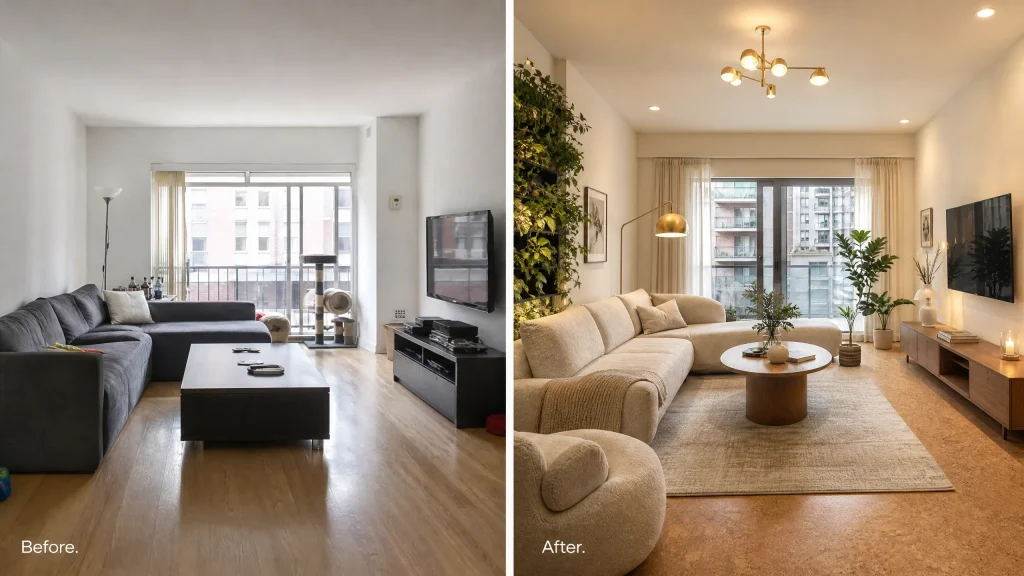
To show what this looks like in practice, here is a recent project from our own portfolio.
A 1,500 sq. ft. apartment in Banani, renovated for a family who wanted a calmer, healthier home without losing the polished, high-end feel they were used to.
Replaced laminate flooring with cork flooring in the living areas — chosen for its warmth, sound-dampening, and renewable sourcing
Switched all wall paint to zero-VOC finishes throughout the apartment
Built a vertical wall of air-purifying plants in the main living area, creating a courtyard-like feel without any structural changes
Reupholstered existing furniture in organic linen rather than replacing it outright
Less Furniture Waste
Major Pieces Retained
Zero-VOC Paint
The renovation also delivered a noticeably cooler living space during peak summer months, attributed largely to the cork flooring and improved natural ventilation planning.
The family’s biggest comment after move-in was not about how the space looked — it was that the apartment “felt different to breathe in.” That is, in many ways, the entire point of sustainable interior design.
Creating an eco-friendly home is a series of small, deliberate choices rather than one dramatic overhaul. Whether you’re starting from scratch or reworking a single room, our team at Intros Space designs spaces that are as healthy for you as they are for the planet.